
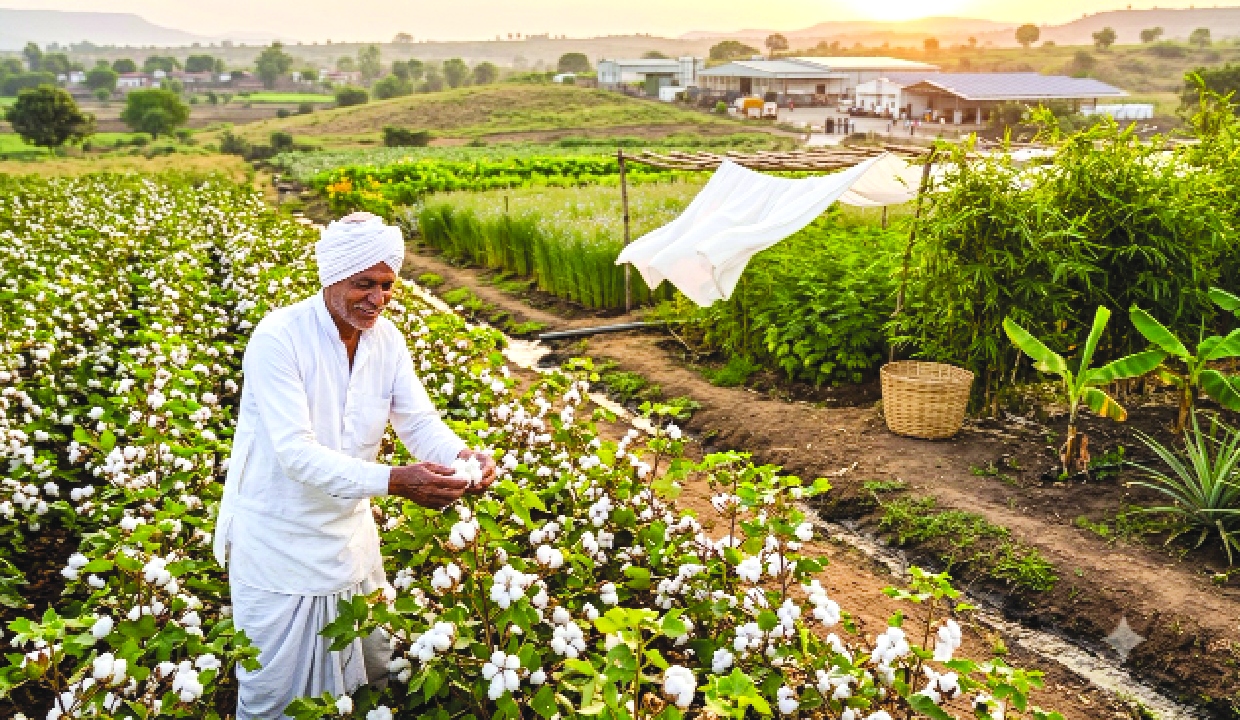
India is strengthening its position in the global textile industry by improving cotton productivity while developing a wider range of sustainable, new-age fibres. The focus comes as the country marks World Cotton Day on October 7, highlighting the importance of cotton to India’s farmers, textile manufacturers and rural economy.
India is the world’s second-largest cotton producer and the largest cotton-growing country by acreage. Nearly six million farmers depend directly on cotton, while millions more are linked to ginning, spinning, weaving and garment manufacturing.
The government’s Mission for Cotton Productivity – Kapas Kanti, with an outlay of more than ₹5,000 crore, aims to raise cotton lint productivity from 440 kg to 755 kg per hectare and increase production to 498 lakh bales by 2030-31. The programme focuses on high-yielding and climate-resilient varieties, modern farming practices, research, quality improvement and traceability.
Digital systems such as CotBiz and the Bale Identification and Traceability System are also being used to improve transparency and efficiency across the cotton value chain. At the same time, Kasturi Cotton Bharat is helping position Indian cotton as a quality-certified and traceable fibre in international markets.
Productivity improvements are another major priority. The High-Density Planting System (HDPS) has helped increase seed cotton yields in participating areas, with the government targeting further gains through improved varieties, agronomic practices and farmer support.
However, rising fibre demand means cotton alone cannot meet India’s future requirements. The country’s fibre demand is projected to increase from around 15 million tonnes currently to nearly 23 million tonnes by 2030.
New-age fibres gain strategic importance
India is therefore expanding its focus to new-age fibres such as milkweed, flax, ramie, sisal, kapok, hemp, bamboo, banana, nettle and pineapple leaf fibre.
A dedicated ₹300 crore allocation under the cotton productivity mission is aimed at supporting research, development and commercialisation of these fibres. These materials have applications across apparel, home textiles, technical textiles, automotive products, packaging, insulation and bio-composites.
Pineapple leaf fibre, for example, can convert agricultural residue into textiles and leather alternatives, while banana fibre can be used in yarn, furnishings, paper and technical applications. Sisal and ramie also offer opportunities in automotive, construction and technical textiles.
The wider strategy reflects growing global demand for renewable, biodegradable, low-carbon and traceable materials. By combining its traditional cotton strength with new-age fibre innovation, India aims to build a more diversified and sustainable textile industry.
The approach also supports the 5F vision, connecting Farm to Fibre, Fibre to Factory, Factory to Fashion and Fashion to Foreign markets. India’s next phase of textile growth is therefore expected to combine cotton heritage, sustainable fibres, technology and global market opportunities.


No comments yet. Be the first to share your thoughts!